
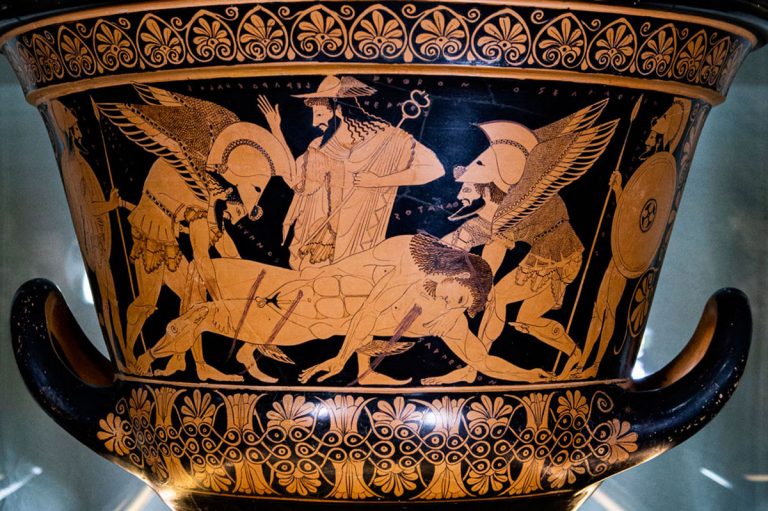
In Cerveteri, the charm of the landscape immersed in nature and the atmosphere of the natural park bear witness to the historic relationship between man and nature, which has ensured the preservation of an extraordinary wealth of history, biodiversity, and landscapes.
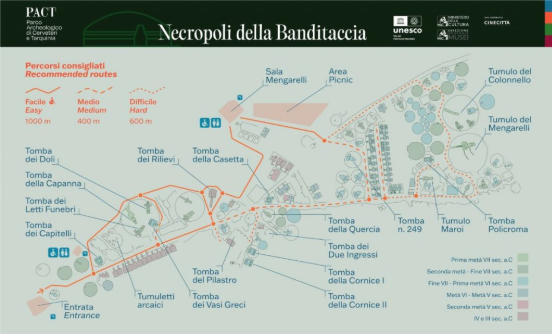
The Banditaccia Necropolis of Cerveteri was the largest—and remains today the most important—of the city’s burial grounds. It extends over an area of about 20 hectares and contains hundreds of circular tumuli, beneath which lie Etruscan tombs dating from a very wide time span, from the 8th to the 2nd century BC.
It is one of the largest necropolises of the ancient world. Crossed by a funerary road over 2 km long, it developed from the 9th century BC through the Hellenistic-Roman period. The oldest tombs are of the well type, with cremation burials inside biconical urns, and of the pit type for inhumations.
From the 7th century BC, with the prevalence of inhumation rituals, large tumuli were built with funerary chambers carved into the tufa and decorated with motifs inspired by domestic architecture. These monuments, belonging to high-ranking families, have yielded rich grave goods, often including imported materials from the Near East and Greece.
During the 6th century BC, alongside the medium- and small-sized tumuli, a new type of tomb emerged: cube-shaped tombs (tombe a dado), regularly aligned along the burial streets, as well as caditoia tombs.
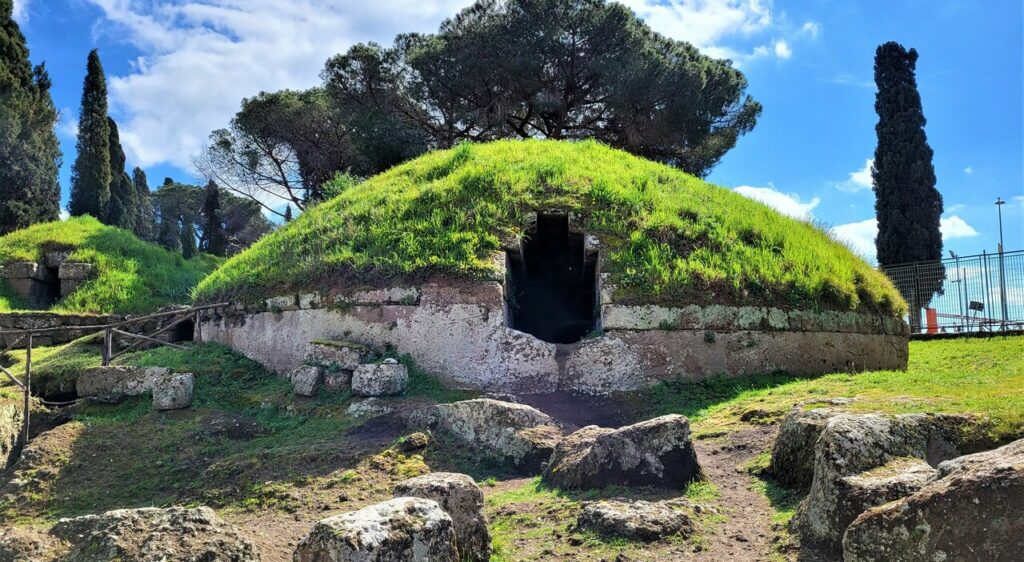
In the 4th century BC, a more common type of hypogeum appeared, consisting of a single chamber with benches set against the walls. Isolated, more imposing funerary monuments belonging to noble families stand out within this context.
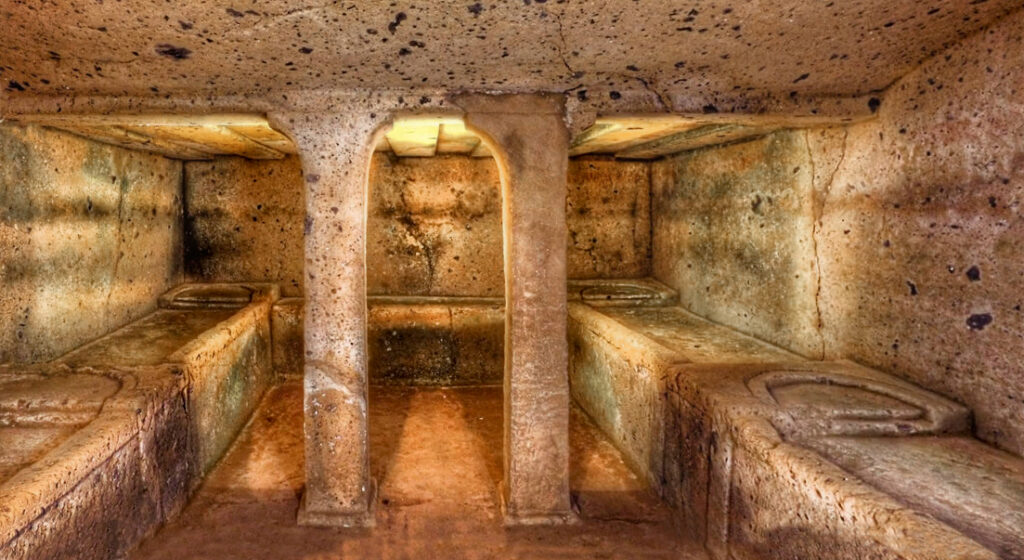
One notable example is the Tomb of the Reliefs, located inside the Banditaccia enclosure, whose walls display a rich array of everyday objects modeled in stucco and painted. Among the so-called “public” tombs, those of the Alcove, of the Sarcophagi, of the Triclinium, and of the Tamsnie family are particularly noteworthy. Together with the Torlonia Tomb in the Monte Abatone necropolis, they bear witness to the extraordinary achievements of funerary architecture in ancient Caere.
MORE INFORMATION ON : https://pact.cultura.gov.it/necropoli-della-banditaccia-di-cerveteri/